10 Effective Strategies to Crack Competitive Exams Successfully
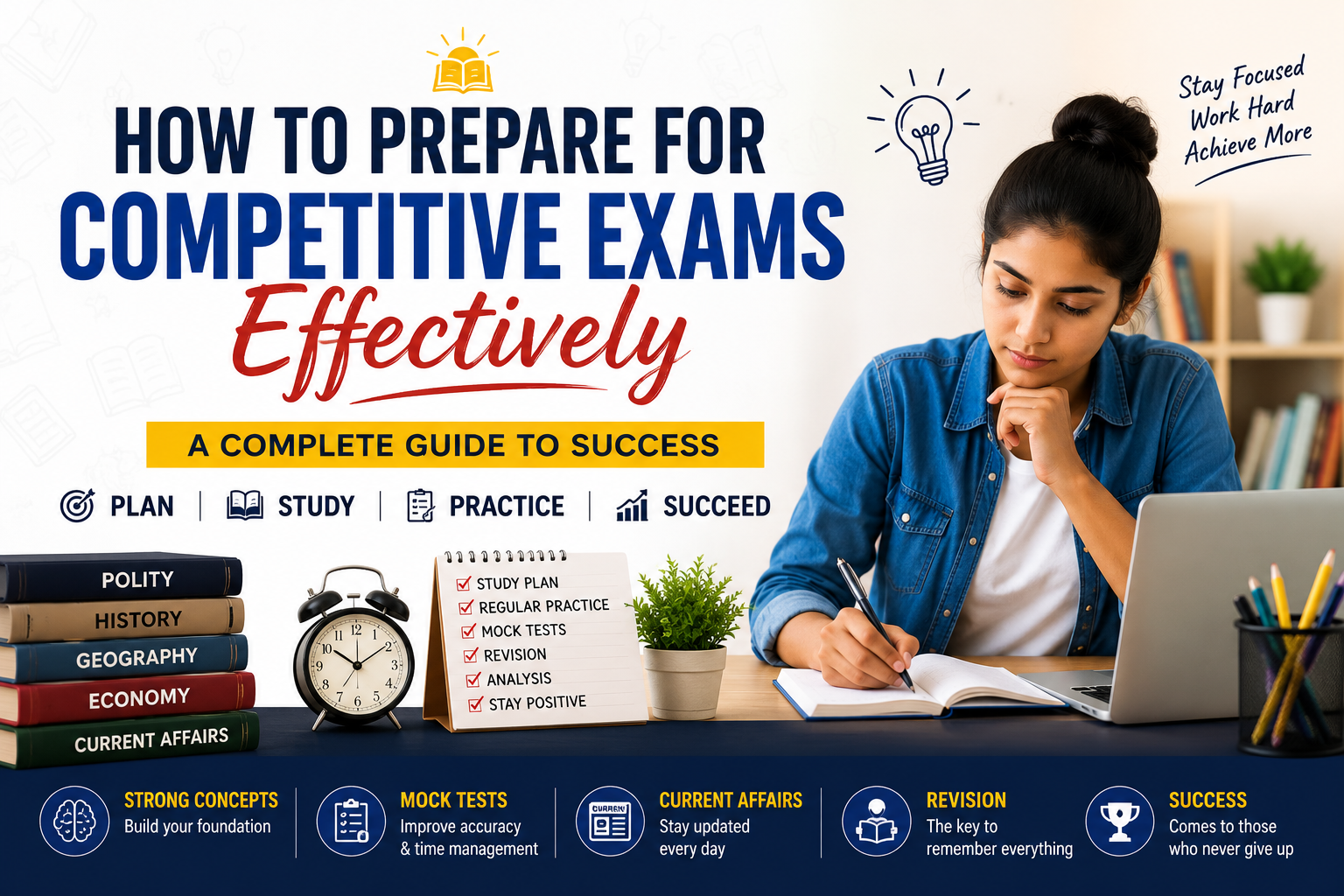
How to Prepare for Competitive Exams Effectively: A Complete Success Guide
Competitive examinations have become increasingly challenging in today's highly competitive environment. Whether you are preparing for UPSC, OAS, SSC, OSSC, OSSSC, Banking, Railway, CT, B.Ed., NEET, JEE, or any other government or entrance examination, success depends on a combination of proper strategy, discipline, consistency, and continuous practice.
Many students work hard, but only those who prepare smartly and consistently achieve their desired results. This comprehensive guide will help you build an effective preparation strategy for any competitive examination.
1. Understand the Exam Pattern and Syllabus
The first step toward successful preparation is understanding the examination thoroughly.
Every examination has its own:
-
Detailed syllabus
-
Exam pattern
-
Marking scheme
-
Time duration
-
Subject-wise weightage
-
Selection process
Students should carefully analyze the official syllabus and review previous years' question papers to understand the nature of questions, important topics, and frequently asked concepts.
A clear understanding of the exam structure helps candidates prepare in the right direction and avoid wasting valuable time on irrelevant topics.
2. Create a Proper Study Plan
A well-organized study schedule is essential for effective preparation.
Your daily timetable should include:
-
Theory study sessions
-
Practice and problem-solving
-
Revision time
-
Mock tests
-
Current affairs preparation
Instead of studying for long hours occasionally, focus on studying consistently every day. Even a few productive hours daily can produce excellent results when maintained over a long period.
Remember, consistency beats intensity.
3. Build Strong Fundamental Concepts
Strong basics are the foundation of success in any competitive examination.
Focus on developing conceptual clarity in:
-
Mathematics
-
Logical Reasoning
-
English Grammar
-
General Science
-
History
-
Geography
-
Indian Polity
-
Economy
NCERT books and standard reference materials are highly recommended for building strong fundamentals. Once the basics are clear, advanced topics become much easier to understand.
4. Practice Previous Years' Question Papers
Previous years' question papers are among the most valuable preparation resources.
They help students:
-
Understand the exam pattern
-
Identify important topics
-
Improve speed and accuracy
-
Build confidence
-
Learn time management
Regular practice of previous years' papers allows candidates to become familiar with examination trends and frequently repeated concepts.
5. Importance of Mock Tests
Mock tests are one of the most powerful tools for competitive exam preparation.
Benefits of regular mock tests include:
-
Better time management
-
Reduced examination anxiety
-
Improved accuracy
-
Performance evaluation
-
Identification of weak areas
After every mock test, spend time analyzing mistakes and understanding where improvements are needed. The learning process after a mock test is often more valuable than the test itself.
6. Focus on Current Affairs
Current affairs play a significant role in many competitive examinations.
Develop the habit of reading newspapers and reliable news sources daily.
Prepare notes on:
-
National news
-
International events
-
Economy and Finance
-
Science and Technology
-
Sports
-
Awards and Honours
-
Government Schemes
-
Important Days and Events
Monthly revision of current affairs is equally important to retain information effectively.
7. Revision: The Secret to Success
Without regular revision, even the most dedicated students tend to forget important information.
Follow a structured revision strategy:
-
Daily revision of important topics
-
Weekly revision sessions
-
Monthly comprehensive revision
-
Quick revision before examinations
Short notes, charts, flashcards, and mind maps can significantly improve revision efficiency and help retain information for longer periods.
8. Improve Answer Writing Skills
For descriptive examinations such as UPSC, OAS, and various state-level examinations, answer writing practice is crucial.
Students should:
-
Write answers regularly
-
Follow a proper structure
-
Use simple and clear language
-
Practice within time limits
-
Focus on presentation and clarity
Well-structured answers not only improve readability but also increase scoring opportunities.
9. Maintain Discipline and a Positive Mindset
Competitive exam preparation is a long-term journey that requires patience and perseverance.
Students often face challenges such as:
-
Stress
-
Low confidence
-
Temporary failures
-
Lack of motivation
During such situations, it is important to:
-
Stay positive
-
Avoid comparing yourself with others
-
Maintain self-discipline
-
Focus on continuous improvement
-
Trust the preparation process
Success belongs to those who remain committed even during difficult times.
10. Take Care of Your Health
Physical and mental well-being directly influence academic performance.
Students should:
-
Get adequate sleep
-
Eat nutritious food
-
Exercise regularly
-
Stay hydrated
-
Avoid excessive mobile and social media usage
-
Take short breaks during study sessions
A healthy body supports a focused mind, leading to better concentration and productivity.
Conclusion
Success in competitive examinations does not come overnight. It requires smart planning, regular practice, continuous revision, patience, discipline, and self-belief.
Every student has the potential to achieve success with proper guidance and consistent effort.
Always remember:
Consistency is more powerful than temporary motivation.
Stay focused on your goals, work hard every day, learn from your mistakes, and never give up.
Your dedication today will determine your success tomorrow.
Final Thought
"Dream Big, Stay Disciplined, and Never Stop Learning."